

Licensing
- Cisco Networking Subscription Licensing
- This article describes the Meraki Subscription Licensing model, highlighting its flexibility, ease of management, and network-specific binding, which allows for tailored licensing terms and simplified compliance across different hardware devices.
- Device Backward Compatibility: Customer Experience, License Eligibility, and Management Guidance
- Selecting Management Mode for Next Gen Hardware with Unified Licenses
- Subscription - License Compliance Cloud Experience
- Subscription - Licensing Changes Cloud Managed
- Subscription - Licensing Claim Cloud
- Subscription - Licensing FAQs
- Subscription - Licensing Network Binding
- Subscription - Licensing Renewals
- Subscription - Licensing SKUs
- Subscription - MG Licensing
- Subscription - MR Licensing
- Subscription - MS Licensing
- Subscription - MT Licensing
- Subscription - MV Licensing
- Subscription - MX Licensing
- Subscription - SM Licensing
- Subscription - Unified Licensing Cisco 8000 Series Secure Routers
- Subscription - Unified Licensing Cisco Smart Switching
- Subscription - Unified Licensing Wi-Fi 7 APs
- Subscription - Z Licensing
- Subscription Advantage Feature Tier Trials
- Subscription Feature Tier Update
- Co-Termination Licensing
- All current Cisco Meraki products require valid licensing to operate. This article describes how Cisco Meraki licensing operates and applies to an Organization.
- Co-Termination Licensing FAQs
- Co-Term License Problem - Out of Compliance
- Co-Term Out-of-Licensing Compliance Warnings and Solutions
- How to do a License Transfer in Cotermination
- License Info Page - Co-Termination License Model
- Meraki Licensing - License More Devices vs Renewal
- Meraki MR License Guide
- Meraki MX/Z Security and SD-WAN Licensing
- Removing and Undoing License Claims - Co-Termination Licensing
- Systems Manager Licensing
- The Science behind Licensing Co-Termination
- Using the License Calculator
- General Licensing Information
- Cisco Cloud Entitlement for DNA
- Claiming Devices and Licenses in a PDL Organization
- Converting an Organization From Co-term to Per Device Licensing
- Converting Meraki Co-Term Licensing to Subscription Licensing
- General Licensing FAQs
- How to unassign a queued license in PDL
- Meraki Hardware and Software Onboarding Guide
- Meraki Per-Device Licensing - Configuration
- Meraki Per-Device Licensing Overview
- Per-Device Licensing (PDL) FAQs
- Subscription License Recommendations for Co-Term Organizations
- The Science behind Per-Device Licensing
Learn more with these free online training courses on the Networking Learning Hub:
Cisco Meraki offers three licensing models: Subscription Licensing, Co-Termination Licensing (co-term), and Per-Device Licensing (PDL). While each serves a purpose, Subscription Licensing is the only model designed for flexibility, scalability, and long-term resilience.
As of September 2023, if you are creating a new Meraki organization, you will automatically default to the co-term licensing model. If you wish to be on Meraki subscription licensing, your organization will be changed automatically once you claim a subscription licensing key in the Meraki dashboard. Per-device licensing is no longer available for new customers. You are not able to mix and match any of the licensing models.
Meraki Subscription Licensing
Subscription Licensing makes license management effortless while keeping your network online and adaptable. Its most important advantage is Amber Mode, which ensures your network continues to pass traffic even if you fall out of compliance — eliminating the risk of sudden shutdowns. Combined with flexible billing, simplified SKUs, and scalability, Subscription Licensing is the best choice for organizations that want to stay future-ready.
How it works:
- Available globally for new and renewing customers (except in Russia, and Belarus).
- Activated when a subscription license key is claimed in the dashboard.
- Licenses managed per subscription at the network level.
Key benefits:
- Amber Mode: prevents downtime if licenses lapse.
- Flexible billing: monthly, quarterly, annual, or prepaid.
- Simplified SKUs & unified license support.
- Auto-renewable for seamless operations.
- Scales easily for franchises or distributed business units.
Best for organizations that want flexibility, resiliency, and future-ready scalability.
Meraki Subscription licensing is available for new and renewing customers globally except in Russia, and Belarus. For more information please visit - Meraki Subscription Licensing Overview.
Meraki Co-Term Licensing
Meraki co-term licensing is applied on an organization-wide basis, resulting in a single expiration date for every Meraki device managed in an organization. That date is dynamically calculated based on a weighted average of the license types purchased and claimed into your dashboard organization. This is accomplished by averaging all active licenses together and dividing by the license limit, or allowed count of Meraki devices in the organization. The single expiration date for all Meraki devices in that organization is dynamically recalculated (by the Meraki dashboard) with each license and hardware claim.
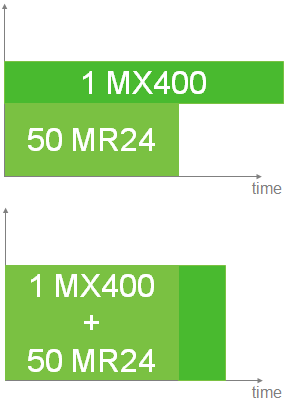
For example, suppose an organization had two separate Enterprise AP licenses, one license for 2x access points spanning one year (365 days) and another for 1x access point spanning five years (1,825 days). The co-termination value would be calculated as ((1825*1)+(365*2))/3= 851 days total for all three access points. So assuming all three licenses were applied on the same day, the organization would have a co-term date of 851 days from the start date of the licenses.
While Co-Term provides predictability for stable, centralized networks, it lacks critical protections like Amber Mode and requires prepaid, fixed-term commitments.
- Prepaid terms: 1, 3, 5, or 7 years
- Single org-wide expiration date
- No Amber Mode → Risk of downtime if out of compliance
Best only for existing customers with simple, static setups who prefer to keep things as they are.
For more information, refer to the Meraki Co-Termination Licensing Overview document.
Meraki Per-Device Licensing
Per-device licensing is no longer available for customers who would like to move to this licensing model for regions where Subscription Licensing is available. Please inquire about our current licensing options for new and renewing customers.
Licensing Model Similarities and Differences
|
Subscription Licensing |
Co-Termination Licensing |
Per Device Licensing |
|
|---|---|---|---|
|
API Automation |
X |
X |
X |
|
Compliance |
Network Management Disable (License Expiration), device continue to function and forward data traffic. Device Management Disable (Exceeding Limit), device continue to function and forward data traffic. |
Organization Shutdown |
Organization Shutdown |
|
End Date |
Fixed |
Dynamic |
Fixed |
| License Expiration Management | Per subscription (at network level) |
Per organization | Per device |
|
Simplified SKUs |
X |
||
|
Multiple Feature Tier Support |
X |
MR & MS only |
|
|
Seamless Upgrades |
X |
Requires Loss of Time or Upgrade SKUs |
Requires Loss of Time or Upgrade SKUs |
|
License Keys |
Require for Origination |
Required for Origination, Additions, and Renewals |
Required for Origination, Additions, and Renewals |
|
Payment Methods |
Periodic or Pre-Pay |
Pre-Pay Only |
Pre-Pay Only |
Why Subscription is the Best Fit for all new and renewing customers.
- Continuity: Amber Mode keeps networks running even if compliance lapses.
- Flexibility: Multiple billing cycles align with budget strategies.
- Simplicity: One model across networks and features.
- Scalability: Built for growing or distributed organizations.
- Future-ready: Designed to integrate with Cisco’s evolving platforms.